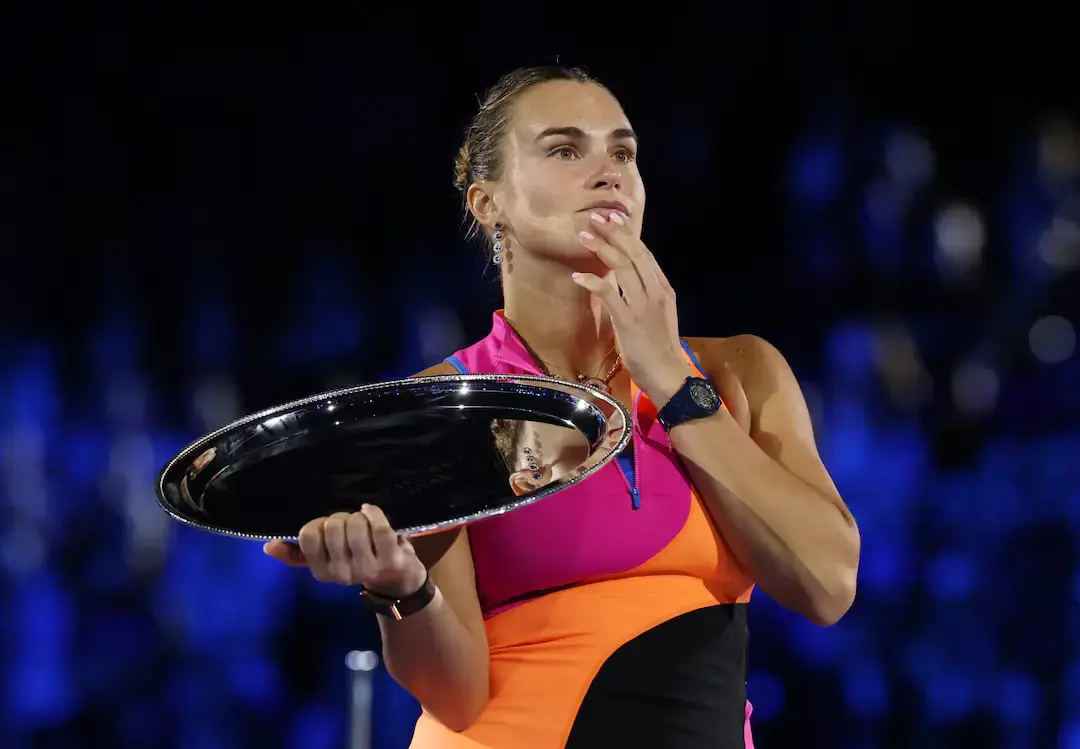
Aryna Sabalenka has a problem with finals. She doesn’t have a problem with reaching finals. She purely has an issue with performing at her best while playing her best with the trophy on the line.
I don’t see the cause of her problem being physical, technical, or strategic, but mental.
Sabalenka is one of the hungriest players in the women’s game, and while this hunger drives her to dominate most of her opponents, it also becomes her kryptonite in big matches. Too often her ambition curdles into desperation, frustration, and exasperation when faced with the final hurdle. If she can learn from her losses and tame her ambition, there’s no stopping this generational talent from cleaning up more Grand Slam champion hardware in the future.
Luckily, there is another champion on tour who has faced and conquered this challenge whom Aryna could learn a lot from. Given that he owns 25 Grand Slam singles titles—the most in the Open era—it’s easy to forget that Novak Djokovic too struggled to conquer this issue in his early career. Perhaps Sabalenka should look towards this champion (and friend) for a blueprint to conquer her demons.
ARYNA’S AMBITION

Sabalenka’s hunger wasn’t always this intense. When Aryna began life on tour, her ambitions were much simpler than winning everything. Period.
At first, she hoped to win ‘a couple of Slams’ by the age of 25 to honor the wishes of her late father. She believed that once she reached that milestone, she would be satisfied and ready to retire. However, after crossing that threshold, her motivations only grew. Now, Sabalenka seeks to ‘get the most out of [her] career’ and cement her legacy. Deep runs at majors no longer satisfy the Belarussian. Last year, when she lost a heartbreaking Australian Open final to Madison Keys, she confessed, “Nobody remembers the finalist. [For me] it’s final or nothing.”
A MENTAL TRAP

That mindset, ‘trophy or bust,’ might sound like a champion’s mentality, but it’s also revealing itself to be a mental trap.
Since 2021, Sabalenka has been the most consistent performer at the Slams:
- She’s reached the semifinals or better in 13 out of 16 appearances.
- She’s appeared in 5 out of the past 6 Grand Slam Finals.
- She’s appeared in the last 7 hardcourt Grand Slam Finals.

Despite this consistency, she often comes up short on the big occasion. Last year, for example, she reached the final of three Grand Slam tournaments but only lifted the title at one. This year, after her loss to Elena Rybakina in Melbourne, her Grand Slam record drops to 4-4—and her overall finals record, 22-20, reveals the pattern more clearly.

Don’t get me wrong—winning four Grand Slams is a monumental achievement that I am not trying to minimize. However, Sabalenka’s weakness in finals becomes glaring when compared to her main rivals. Iga Swiatek is a perfect 6-0 in Grand Slam finals and owns a 25-5 record overall. Elena Rybakina (2-1 in slam finals, 12-11 overall) and Coco Gauff (2-1 in slam finals, 11-3 overall) both boast superior conversion rates. So what explains the discrepancy?
HER OWN WORST ENEMY

The answer is psychological. When faced with pressure, Sabalenka has a habit of becoming her own worst enemy. It’s as if an alternate version takes the court during finals—not the clutch Sabalenka who dominates early rounds, but someone tense, irritable, and self-sabotaging. This was most notable in last year’s French Open final versus Coco Gauff. The stats tell part of the story—70 unforced errors—but her demeanor told the rest. On numerous occasions she would verbally berate her box after mistakes, spiraling deeper into frustration with each game. In her tearful runner-up speech, she proclaimed it “the worst final [she] ever played.” In her post-match press conference, she elaborated:
“The past two weeks I played really tough matches [against] really incredible players. I definitely played at a better level than [in the final]. […] I was overemotional. I think today I didn’t really handle myself quite well mentally, I would say. So basically that’s it.”
While hunger fuels Aryna’s campaign to reach the final, the same force seems to sabotage her on the big day. Too often, she devolves into frustration, stress, and anger because she seems to want it too much.
A FAMILIAR STRUGGLE

Sabalenka’s finals struggles remind me of fellow 2026 Australian Open finalist Novak Djokovic. After his breakthrough 2011 season, which saw him lift three major titles and ascend to World No. 1, Djokovic would go 2-5 in his next seven Grand Slam finals across 2012-2014. To put that into perspective: about 50% of ALL major finals that Novak Djokovic lost in his career occurred during this period.

While his opponents—Rafael Nadal and Andy Murray—were formidable, Djokovic also became his own worst enemy. Like Sabalenka, he would devolve into frustration, anger, and self-recrimination when the pressure mounted. He gained such a reputation for not being ‘clutch’ in crucial moments that Courtney Nguyen’s analysis of the 2013 US Open Men’s Final listed this as a decisive factor in their prediction:
“Djokovic has not been clutch: The No. 1 has struggled to win matches when they balance on a razor’s edge, suffering from mental lapses even when he’s in a winning position.” – Courtney Nguyen, Bleacher Report
NOVAK’S NIGHTMARE

Here’s where the parallel deepens: while Sabalenka’s hunger curdles into desperation, Djokovic’s hunger bred doubt. Once the losses began to pile up, he couldn’t shake the unsettling feeling. After losing the 2012 US Open Final to Andy Murray, he admitted, “I was still doubting myself right up to a few minutes before you go on to play the match. You’re thinking, you know, ‘Are you going to be able to do this? This is going to be tough.'”
After winning the 2014 Wimbledon title—his first major in over a year—he confessed that successive defeats had shaken his confidence: “After losing several Grand Slam finals in a row, I started doubting [myself].” But that victory marked a turning point. The deciding factor, he explained, was refusing to let losses become evidence of inadequacy. Instead, he reframed them as data points for improvement: “It’s an experience. It’s a learning process. It’s understanding, identifying where the problem is, you know. Pushing for it. Working on it. It’s mental at the end of the day. You have to be able to be at the top of your game, mentally fresh and motivated, calm, and composed.”
Djokovic didn’t solve his finals problem overnight. The shift from 2012-2014 to 2015—when he won three of four Grand Slams and reached all four finals—required a complete mental recalibration. He had to stop viewing finals as tests he might fail and start seeing them as stages where he belonged.
A CROSSROADS
Sabalenka stands at the same crossroads now. She has a powerful game, and she’s incredibly hungry to win. The last piece of the puzzle lies in her mentality. Losses need to become lessons, not monuments to failures past. The hunger needs to sharpen her focus as she approaches the finish line, rather than strangle it.
Perhaps it’s fitting that she’s befriended the one player who truly understands what she’s going through. If Sabalenka can learn from Djokovic’s most unreliable chapter of his career, the rest of 2026 could be her greatest season ever.
While nobody may remember the finalist, true champions remember to take lessons from every loss to make themselves better.